On Borders
Notes

Things are known at their limit. We know a person by their flesh & their clothes, we know a concept by its full articulation ending in full stop, we know a book once we’ve set it down, we know (‘by God’) what it is we’ve done in the completion of an act.
The threshold or limit of a thing is its terminus. Coming to a sufficient understanding of a concept, for example, begins the process of its dismantling. Once something can be reasonably articulated it is already in the process of withering-away.
The term Nationalism emerged first in Europe during the period of the intuited Nation’s disappearance, or (in the case of Italy & Germany) by a project to forge something where before nothing existed, often motivated by the vague memory of a lost mythological Polis or Empire. Every -ism of this sort emerges either at the terminus of its object, or in its complete absence (thus the recourse to myth): Feminism’s origin is charted to the inception of women’s ‘necessary’ involvement in the labour force and thus is inexorably linked to the unfolding process of woman’s withering-away, the intuited and pre-cognised feminine metabolised into a function of economy, into the androgynous proletariat. Socialism, whether in progressive or reactionary form, has concerned itself principally with the retrieval of a lost sociality, by whichever means it conceives of. Even minor political projects like agrarianism or Luddism exist to defend the existence of something in its death-throes, something which has reached terminus.
The meaning of a Polis is determined by the existence of the non-Polis, that which is beyond the boundaries of Political law/order. All officers in the employ of the Polis are border guards: their task is the defence of Politics whether from external or internal illegality/disorder.
Outward expansion of the Polis always means risking the integrity/existence of Politics. The more a Polis grows, the more elements must be brought in which brings the Polis into open confrontation and risk of life.
But expansion is necessary for the Polis: if boundaries are not consistently pushed further and further out, the Polis accelerates towards terminus by ‘knowing itself’, first phase of degeneration (naming). See the example of Agrarian sedentary Poleis in the context of nomadic conquest: Poleis which conceived of themselves as closed circuit, something fully satisfied and identical to itself, ahistorical, complete, uninterested in expansion or development, inevitably fall prey to an absolute termination.
The development and further continuity of the Polis being determined therefore by a twofold process: a) the quality and integrity of its borders and border-guards; b) capacity for expansion and dynamic integration/subjugation of new elements (whether that be animals, terrains, resources, or (most importantly) peoples.
Every encounter of the expanding Polis brings wisdom. Every encounter forces the Polis, her subjects, to change themselves, to traverse and endure the unhomely, to bring into the concept of home a greater and greater variety, expands the field of Politics and of philosophical comprehension.
But these encounters necessarily threaten the home, and it is precisely this threat-to-life, or rather the Political response to threat, which gives meaning, vitality to the Polis. The expansion of borders, sublation of that which is encountered, is the fundamental precondition of Anthropogenesis, the birth of a people, not as singular isolated event but as repetition. It is the sacred test.
Thus the nature of borders, their character, reveal the essence of the Polis and peoples: borders are a historical-anthropological index, they are real determinations and explanations of the character of a people.
As the quality of the outermost limit reveals the innermost quality of a Polis, so do the clothes a man wears reveal his character.
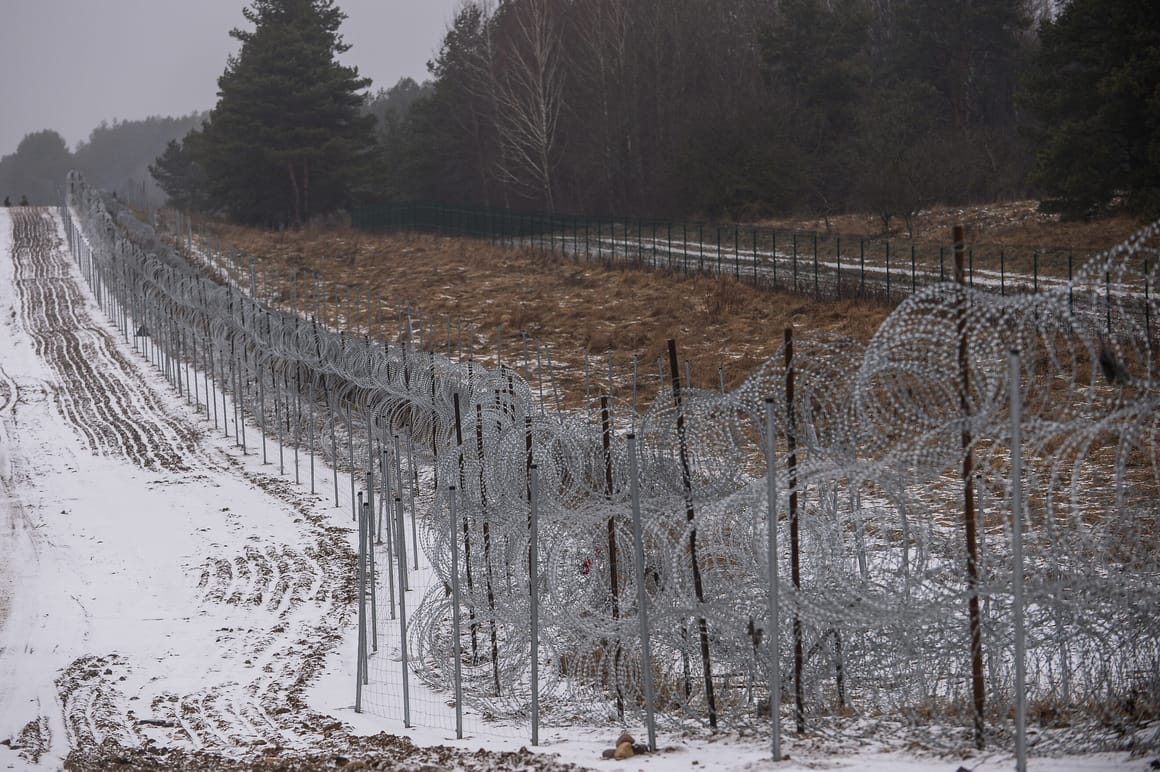
The outermost limits of the Polis are, however, the most unnatural and unhomely environments of the Polis: borders are cold, unwelcoming, inhuman environments; concrete walls, barbed wire, rifles, white lights, metal bars, etc. This is not a contradiction. We see in the transformation of fashion a corresponding transformation of our attitude to borders and border control: The period of bourgeois rule was determined by strong tariffs, hard borders, starched collars; the present period is determined by loose-fitting, revealing clothing, with a corresponding attitude to border control. And despite the ever-more revealing quality of clothing in our Polis, what withers away ever faster is the erotic, the sensual, the tactile. This repeats the conditions of the self-satisfied closed circuit of agrarian sedentary civilisations before their encounter with conquering nomads: Poleis who have reached their limit, open for conquest.
Islamic civilisation, as with all other self-respecting and self-motivated civilisations, is encoded with a drive for conquest and self-defence. This corresponds to their attitudes to dress, particularly female dress. It is no coincidence that the United States promotes rebellion in Iran centred around the headscarf, or why the French struggle ceaselessly to impose their ‘immodest’ standards of dress on Muslim women. The former is an attempt to expand the borders of American unipolar hegemony into the Muslim world, the latter a struggle to secure internal security and re-affirm the integrity of French Political law and the French self-concept. Both reveal a mutual existential risk-of-life, and the early warnings of open confrontation.
The defence of the integrity and quality of a thing by an unwelcoming border is a repeated theme in religious metaphysics. Jacob Frank in his Words of the Lord gives the most honest and open articulation:
Sometimes even though a good thing is displayed, inside it may be filthy; and sometimes though it is nasty on the outside, it may be full of love and goodness inside. For the good and precious thing is always hidden in the evil and filthy, so that a good thing might not be shown, so that everyone can take it, as it clearly stands, God hid their light from the godless. Also it is signified in good and precious roses: they always grow among thorns that absolutely prick him who seeks to pick them.
(from ZPS 684)
The diurnal regime of imagination (introduced by sociologist Gilbert Durand and elaborated philosophically by Alexander Dugin) entails the coming to verticality in the human subject, beginning with the postural reflex, enabling the child to stand upright. Dugin summarises this regime as “dominated by diaeretic operations, such as division, dismemberment, the establishment of clear limits, contemplation, vertical hierarchy, severe logical laws, and is characterised by the concentration of identity towards one end (i.e., the construction of a consolidated subject)”. Here we may draw an immediate connection with Freud: castration serves as the necessary precondition of sexual (thus social) activity. The Phallus as the generative, expansive force must be metaphysically severed/constrained by the force of intellect, reason, law; for human subjectivity to find articulation it must be provided with clear limits, a clear horizon, a terminus. Again, everything is known to us by spatio-temporal limit, and participation requires a certain forgoing of absolute potential so as to attain any partial satisfaction of potential.
The emergence of Eschaton in religious thought entails the realisation of an ultimate threshold of being, an absolute limit. Despite Eschaton being typically characterised as a stepping beyond the limit, it is in effect the psychic force of containment, a metaphysical border which encloses and castrates Being, the necessary conceptual bounds which enable our capacity to act.
Heidegger noted that to declare the end of metaphysics only serves to end our awareness and understanding of metaphysics, and thus lose our capacity to recognise metaphysics, when we ourselves unwittingly and inevitably invoke it. The elimination of castrative metaphysical boundaries from our thinking paradoxically leads to immobility, is in actuality just the loss of awareness of our own castration.
The same is true of borders: to enter into a so-called borderless world is in fact only to lose awareness of borders, thus ultimately to lose awareness of our own Being. Even if the outer limit of a thing cannot be said to exhaust the totality of the thing (indeed, it often exists in apparent contradiction to the thing), we require at the very least an acknowledgement of there being an outer limit, in order to understand the inner quality.
The supposed death of non-liberal ideology at the end of the Cold War period has been proved false, as with the ferver around opening our borders which became entirely mainstream at that time. Neither stood on substantial ground nor had any justification; the recent ‘re-emergence’ of existential threats to the so-called West is not a re-emergence at all, because they never left. All that was left, abandoned at the end of the last century, was our awareness.
The return of ‘ideas’ and ‘ideology’ to politics is always a sign of dusk. Everything that must be articulated or asserted is lost, or withering-away. Liberalism has taken up a militant character again, it has been reacquainted with its primordial risk-of-life (an enormous concession to the revolutionaries). Our world hangs on the question of terminus.